Thursday, February 24, 2011

Saturday, January 29


The next day, Saturday, was a big day for us. This was the day Paul's parents were to leave, the day we tried to get money out of multiple ATM machines only to find they were all out of service, and the day that police were no where to be seen.

After our failed attempt to withdraw money, we went to stock up on food. Could the stores run out of food? Would the employees stop showing up to open the stores? How long would our money last? Paul's parents helped us to stock up. Paul's dad insisted we buy an entire kilogram (over two pounds) of gouda cheese. At noon we said goodbye to Paul's parents. They gave us all of their Egyptian Pounds, hugged us and got into a taxi. From there we could only hope that they would be able to depart. We had heard that all planes had been grounded, but the US Embassy encouraged them to try anyway. In the end, they were on one of two flights that departed for Europe on Saturday. We did not have cell phone or internet service, but we did continue to watch the news on the TV. We knew that, like Friday, Tahrir Square and other parts of downtown swelled with people protesting.
Not long after that we began to hear stories of looting. Apparently with the lack of police, looters were going to the neighborhoods of the wealthy and expats. Already, some of the major stores had been broken into and their merchandise stolen overnight. At about 3 in the afternoon, I looked out on the balcony and my heart sank. I saw men, several dozen of them, standing on the door to our apartment building. They were holding sticks, lead pipes, and knives. Some of them were standing in the street, yelling at those who were standing on our stairs. I ran inside and told Paul what I had seen.
We ran next door to our neighbor’s apartment. I had actually never seen them, but Paul had met them once and told me there was a young woman who teaches English and lives with her parents and other family. So, we went to their door and the English teacher answered. After we introduced ourselves and told them what we had seen she told us, “Do not worry. They are men from our building and they are there to protect us from the looters.”
We live in a big apartment building, it has over 20 floors, and the other buildings by us are like ours, so there are a lot of men to protect us. This gave us some comfort. We returned to our apartment and after about 20 minutes someone knocked on our door. It was our neighbor. She handed us a pitcher and said “Orange juice. Do not worry, they will keep us safe.”
Such kindness in the midst of such anxiety and chaos, but also typical Egyptian hospitality.
That night, there was a lot of noise. Firecrackers, gunshots, whistles, men yelling, and on one occasion, women screaming from a nearby building. We learned we could recognize some gunfire from firecrackers by the rhythm. I remember one point Paul was on the phone with Michelle, updating them again on our situation when he abruptly broke off the conversation with, “Michelle, I hear a lot of gunfire really close to us. I will call you back.”
At one point we woke up in the night to very loud cries from the men downstairs, “Teleta Arabaya.” This means three cars. There was a whole message about these three cars, but our Arabic is not good enough to pick it out. The cries about the three cars began to our left. But the men were passing the message down, and the yelling moved down the block, below us, and then to our right. After a minute, someone from the local mosque, to the right of us, made an announcement over the loudspeaker to the whole community about the three cars.
At another time, we awoke to men yelling “Mustashfa!” This is the word for hospital. We crept out on our balcony, on our bellies because there was still gunfire, to see what was happening, because the hospital is just across the street from us. We saw lots of men had climbed up on the hospital wall, looking out into the complex. After some time and some yelling, they gave up what they were looking for and dropped back onto our street. Sure enough, when they dropped off the wall, we saw a man go running through the hospital field.
These groups protecting their homes became known as neighborhood watch groups. Throughout the city people had organized themselves. In many cases they organized themselves so that they protected in shifts, some sleeping at home while others were outside. When they were successful at catching looters, they were turned in to the army, who arrested them.
The last time we talked with Peter on the phone he told us we were going to leave. In the morning, he would pick us up in his car and we would go to the airport. So we packed our second bag and two carry on bags, unsure of what would happen or if we might return.

Tuesday, February 15, 2011

Protests Spread


The first thing I remember about Friday morning was surprise. We had no cell phone service and no internet. It was surprising just how cut off we felt from the rest of the world. We did have an antique (literally) phone that worked through the land line, which was not shut off. We could call people locally through that.

This was supposed to be Paul's parents' last day in Cairo. So in the morning we did what everyone does on their last day, we went souvenir shopping. There were not many people out on the streets, but they were by no means empty. And the shops were open. When we saw our first protesters they went marching along an overpass that crossed the street we were on. They were chanting loudly, but walking peacefully. It took about a minute for them to pass. Later, at lunch, Paul's father came to me after looking at the TV and said, “Wow, they really came out for this today.” He was referring to the news showing downtown filling with people.

Before long we were back at home, glued to the news. People had filled the downtown areas, especially Tahrir Square, the place where Paul and his parents had been just last week to see the museum. At some  point, I remember reports the police were using tear gas. Then I remember reports that the police were firing rubber bullets at protesters. We could go out on our balcony and could see smoke from downtown. Soon it was dark. Down the street from us we could hear a lot of commotion.  Then from somewhere close, we started to hear gunfire. And we could hear a big crowd of people. The TVs were showing videos of the protesters trying to push police trucks into the Nile. Reports were that the people had become very angry with the police. Then, down the street, we could see the crowd we had been hearing, illuminated by a fire. Our local police station, and the trees surrounding it began to burn. We could see throngs of people running around it, throwing things at the building. We had begun to regularly update our boss Peter, and we called him once again.

It is difficult to explain why the people would attack the police. There could be many reasons. Whatever the reason, Friday night, the people of our community expressed their anger as a powerful group. I remember as went to bed that night Paul said, “If I were a police man I just wouldn't show up to work tomorrow.” With this thought in our heads, listening to the protests continuing on our street, we tried to sleep.

Friday, February 11, 2011

Ramping Up...

How to define such a historic moment for Egypt? I don't imagine we can in any complete way, but here's a description of our experiences of the first few days of protests. We'll share more stories soon.

The first of the large protests was scheduled for a Tuesday which the government was calling “Police  Appreciate Day.” A few days before this we were actually (ironically) on vacation with my parents several hours to the south of Cairo. Our first hint that this could be big was from our tour guide who told us that he was getting countless facebook messages from his friends encouraging him to join a big anti-government protest for an event that the people were renaming“Police Brutality Day.”

We arrived back in Cairo from our vacation Tuesday morning. When we arrived at the train station our driver loaded us into his van, but then he said that we needed to wait a minute so that a police car could escort us back to our place. Our driver assured us that this was normal, but Stephanie and I new that it was not, because we had never heard of or seen such a practice before. But we arrived back in our apartment easily enough,. The protests on Tuesday were very large indeed.

For the next two days one could avoid the reality of the protests if one wanted to, as they were confined to the downtown area around Tahrir square. On Wednesday, which was the day Stephanie took my parents to see the pyramids just outside of Cairo, I (Paul) got word that protests in Tahrir square were getting heated, and so I decided I needed to give them a call to warn them to avoid driving through downtown on their return journey. I heard Stephanie pick up and began to speak my warning, but was interrupted with...  “Paul, your mom is getting on a camel!!! Woo Hoo!!!”

This was not what I wanted to talk about. But the surreal truth of that moment was that Cairo existed in two worlds. One that was the same as always, and one that existed downtown that called for drastic change. But they arrived home safe, and Thursday was similar in it's split reality to Wednesday.

On Friday, the protests came to us all...

Thursday, February 3, 2011

Back in the United States

Due to unrest in Egypt we have been evacuated. We are now back in the United States. Thanks for your continued prayers and well wished for us, and for the Middle East. We will share stories and updates as time goes on.

Paul and Steph

Friday, January 7, 2011

Struggles and Solidarity

I was stopped by the police as I was walking into our church compound for worship this morning. “What is your name?” I was a little nervous, I have never been stopped by them before.
“Stephanie,” I told him.
“Where are you from?” he asked.
“The US.”
“The US?”
“Yes, I'm American.”
At this point, our usual gatekeeper came out and said something in Arabic and the officer told me I could go on in.

Some other members we questioned or had to show their ID's before entering. The increase in security is a result of a bombing that happened on New Years. The bombing was in Alexandria, a city a couple of hours away from us. In the bombing, 22 people were killed and many others were wounded as they were leaving a church service. In the aftermath there has been some protesting, some anger, a lot of sadness, and some solidarity between Christians and Muslims.

We should tell you that the violence here was aimed at Egyptians and not foreigners. Our everyday life has not been interrupted and we feel as safe as ever. Our hearts go out to those who lost loved ones, or who feel uncertain about their safety now.

Last night was Coptic (Egyptian Christian) Christmas Eve. A woman at church told us the story of the Christmas Eve service her daughter attended. Inside the church it was packed. All of the seats were full and there were crowds of people standing. Outside the church, Muslim men stood guard. They were lined up along the outer gates and sides of the compound. These men were not paid, not security guards, they were everyday Egyptians, in a powerful display of solidarity with their Christian neighbors. Thanks be to God for this.

Let us join with the Egyptian people as we pray for healing and peace in this place.

Thursday, January 6, 2011

Happy New Year!

To start things off, we'll go back to mid December, when the semester ended at school. We had a wonderful time of celebration! First we had a day of sports. The kids were all really into this. In this video you can see some of the children cheering for their team. "Mandella! Ohoh-ohoh."


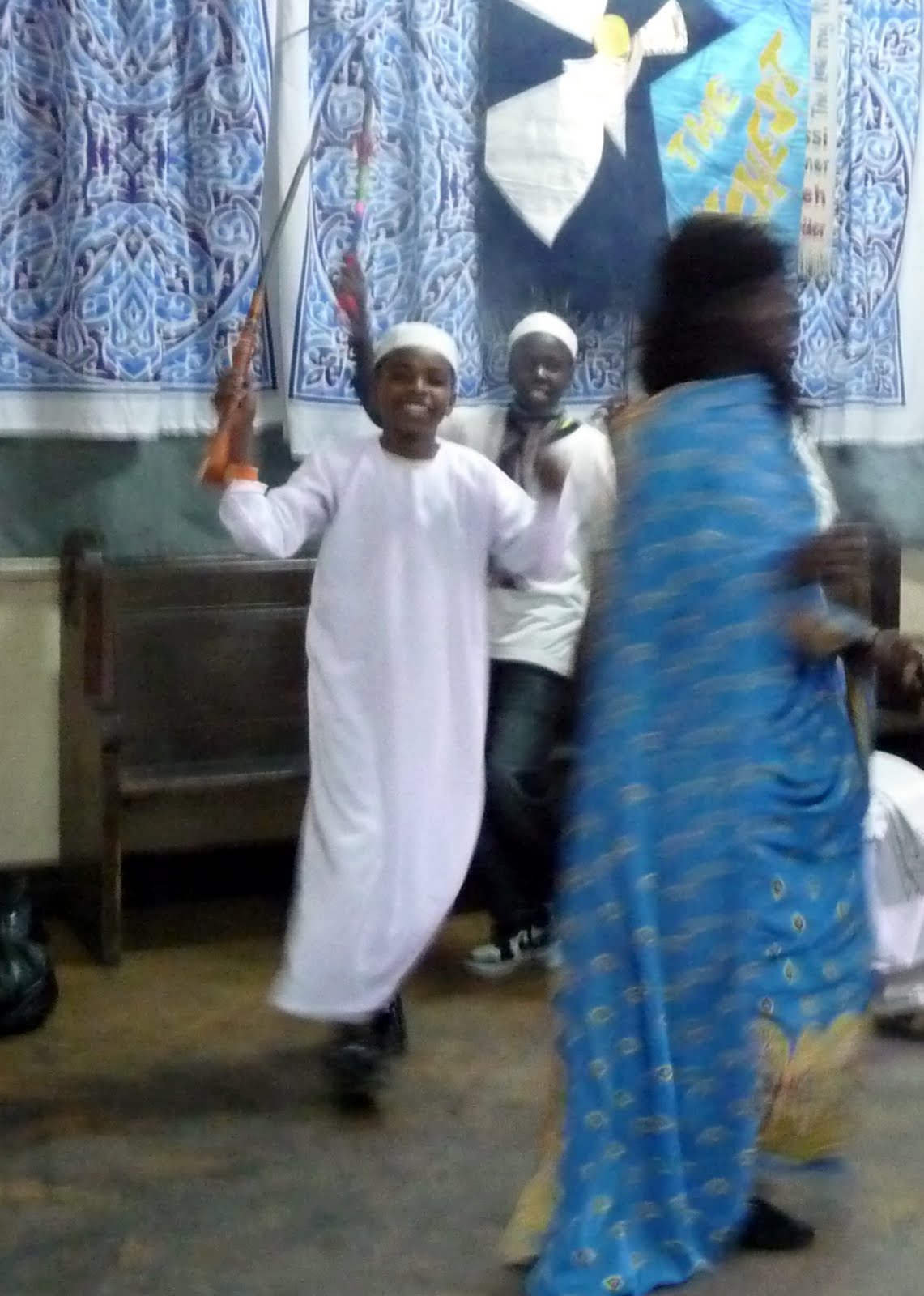
The very last day of school was the closing ceremony. Students and their parents filled all of the seats and floor space of our Guild Hall. The students were given awards and performed dances. Here some of the children are in costume, performing a Sudanese wedding dance.

Before Christmas we spend some time preparing our worship space for the festivities. First, the congregation had a cleaning day. We came together to wipe away the layers of dust that inevitably covers everything in Cairo. In this picture Paul and some congregation members are working in the sanctuary. Then we had a decorating day. In addition to the usual Christmas decorations, we used the beauty of God's creation with a live Christmas tree and green leaves from the trees outside to spruced up our windows. For us living in the desert, green plants have become very, very beautiful indeed.

It is an interesting thing, celebrating Christmas in a country that doesn't. Unlike the US where stores and the media start reminding that it will soon be Christmas more than a month in advance, here it is mostly unnoticed. But still, Christmas in Cairo was wonderful. We had a beautiful Christmas Eve service with lots of hymns, some from the American tradition, some from other places. Paul attended a Christmas Day service for the Sudanese churches. The 3 hour service included lots of singing, preaching, and even baptisms.

Finally, we really celebrated New Year's in style. A church member lives in a very tall building. We joined her on her roof for a small party. We were on top of one of the tallest buildings in Cairo. We watched boats go along the Nile and the huge expanse of city lights. And then, it was New Year's and we were above all the fireworks. From up there, we could see them all around us. It was really amazing.

Sunday, December 5, 2010

Belly Button Lessons

Last week in the 8th grade class, the textbook mentioned the umbilical cord. This seemed to be a new term for all of the students. So I found myself explaining the function of the umbilical cord and the way it is cut after a baby is born. This led to another new term: the belly button. I wished I could just raise my shirt and show mine, as often an image is the quickest way to explain something, but obviously that would be inappropriate, so I settled for describing it in words.

As we were talking, a girl in the class had this look on her face, clearly she had just had some kind of revelation. She raised her hand and when I called on her she said, “Teacher, boys have a belly button too?” At this most of the boys ducked their heads, looking down at their stomachs, thinking about their own belly buttons I guess. Some of the girls quietly snickered, but most politely listened as I assured her that yes, we all have a belly button.

This experience in class really has me curious. How could she not know that boys have belly buttons? Maybe she doesn't have a brother or a father. Maybe she's never watched TV. But really, has she never ever seen a little boy without his shirt? Or, maybe upon learning something new, she forgot something she had once known. Another possibility though is that she does have a father or brother but they all live in extreme modesty. This idea of extreme modesty is very interesting to me.

Perhaps more applicable for me, it reminds me that I can not assume the kids in my classes have knowledge or exposure to things I would have by their age. Also, there are topics where they have seen and understand so much more than I ever will. Part of my job is figuring out these differences. Even though I am the one called “teacher”, on my good days we share and learn from each other.